

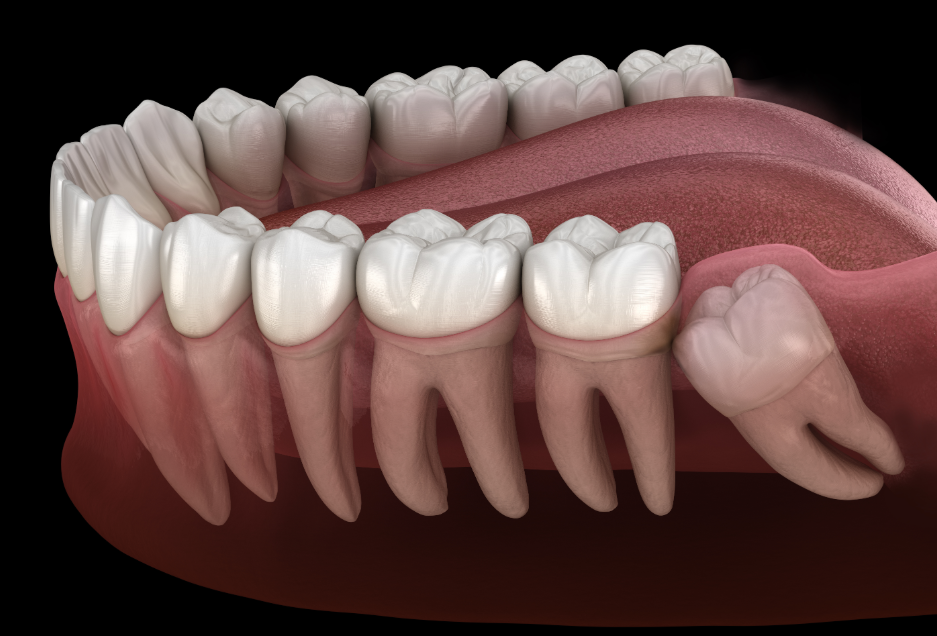
Wisdom teeth have a reputation for causing trouble, and for good reason. While some people have enough room for these final molars to emerge normally, others develop wisdom teeth that become trapped beneath the gums. In some cases, a wisdom tooth can even grow sideways or almost horizontally instead of moving straight up into the mouth.
So, why does this happen? Often, the answer comes down to one simple problem: there isn’t enough room.
Why Do Wisdom Teeth Grow Sideways?
Wisdom teeth are the last permanent teeth to develop and typically emerge during the late teens or early twenties. By the time they are ready to come in, your other permanent teeth have already occupied much of the available space in your jaw.
When there isn’t enough room for a wisdom tooth to erupt normally, it can become impacted. Rather than moving vertically toward the surface, the tooth may angle forward, backward, or sideways. A tooth that grows almost completely horizontally is sometimes referred to as a horizontally impacted wisdom tooth.
Jaw size and the position of the developing tooth can influence whether there is enough space for normal eruption. Genetics also appear to play a role in how wisdom teeth develop.
What Does an Impacted Wisdom Tooth Look Like?
You may not be able to tell that a wisdom tooth is growing sideways simply by looking in your mouth. If the tooth remains beneath the gumline, there may be no visible sign that anything is wrong.
That’s why dental X-rays are so useful. Imaging allows your dentist to see the position of wisdom teeth beneath the gums and determine whether they’re developing normally or becoming impacted.
Some people with impacted wisdom teeth don’t experience symptoms at first. Others may eventually develop pain, swelling, tenderness, difficulty opening their mouth, or irritation around the back of the jaw.
What Problems Can Sideways Wisdom Teeth Cause?
An impacted wisdom tooth isn’t automatically a dental emergency, but it can create problems if it begins affecting surrounding structures.
For example, a sideways wisdom tooth may press against the neighboring molar. This can contribute to damage or make the adjacent tooth more difficult to clean properly. Food and bacteria can also become trapped around a partially erupted wisdom tooth, increasing the risk of tooth decay and gum inflammation.
Impacted wisdom teeth can also be associated with infections around the gum tissue, known as pericoronitis. In some cases, cysts or other changes can develop around an impacted tooth.
The likelihood of complications varies from person to person, which is why monitoring wisdom teeth is important even if they aren’t currently causing pain.
Do Sideways Wisdom Teeth Need to Be Removed?
Not necessarily every impacted wisdom tooth requires removal. Your dentist will consider factors such as the tooth’s position, your age, symptoms, oral hygiene, and whether the tooth is affecting neighboring teeth or surrounding tissues.
However, if an impacted wisdom tooth is causing pain, infection, damage, or other complications, extraction may be recommended. Removing the tooth can prevent or address problems associated with its position.
If extraction is recommended, your dentist can explain what to expect before, during, and after the procedure.
Don’t Wait for Wisdom Teeth to Hurt
Because impacted wisdom teeth can develop without obvious symptoms, regular dental examinations are an important part of monitoring them. An X-ray can reveal what is happening beneath the gums long before a sideways wisdom tooth causes noticeable trouble.
If your wisdom teeth are growing sideways, early evaluation can help you understand your options and address potential problems before they become more complicated.
Sometimes, the best way to deal with a troublesome wisdom tooth is to catch the problem before it has a chance to cause trouble.
About the Practice
Fort Worth Dental provides comprehensive dental care, including wisdom teeth evaluations and extractions. The practice focuses on personalized treatment and helping patients understand their dental options so they can make informed decisions about their oral health. Our team of dentists will have you smiling brighter and feeling better in no time!
Call us at (817) 592–8763 or schedule your appointment online.